School Projects
Saturday, 9 April 2016
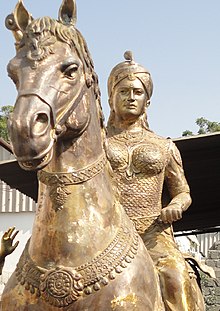
Rani Rudrama Devi
B. R. Ambedkar
Dr. Bhimrao Ramji Ambedkar ([bʱiːmraːw raːmdʑiː aːmbeːɽkər]; 14 April 1891 – 6 December 1956), popularly known as Babasaheb, was an Indian jurist, economist, politician and social reformer who inspired the Dalit Buddhist movement and campaigned against social discrimination against Untouchables (Dalits), while also supporting the rights of women and labour.[4][5] He was Independent India's first law minister and the principal architect of the Constitution of India.[6][7][8][9]
Ambedkar was a prolific student, earning a law degree and various doctorates from Columbia University and theLondon School of Economics, and gained a reputation as a scholar for his research in law, economics and political science.[10] In his early career he was an economist, professor, and lawyer. His later life was marked by his political activities; he became involved in campaigning and negotiations for India's independence, publishing journals advocating political rights and social freedom for Dalits, and contributing significantly to the establishment of the state of India. In 1956 he converted to Buddhism, initiating mass conversions of Dalits.[11][12][13][14]
Tuesday, 29 March 2016
Srinivasa Ramanujan
Srinivasa Ramanujan FRS (pronunciation:
i/ʃriːnivɑːsə rɑːmɑːnʊdʒən/) (22 December 1887 – 26 April 1920) was an Indian mathematician and autodidact. Though he had almost no formal training in pure mathematics, he made extraordinary contributions to mathematical analysis, number theory, infinite series, and continued fractions. Ramanujan initially developed his own mathematical research in isolation; it was quickly recognized by Indian mathematicians. When his skills became apparent to the wider mathematical community, centred in Europe at the time, he began a famous partnership with the English mathematician G. H. Hardy. He rediscovered previously known theorems in addition to producing new theorems.
Pythagoras
Pythagoras of Samos (US /pɪˈθæɡərəs/;[1] UK /paɪˈθæɡərəs/;[2] Greek: Πυθαγόρας ὁ Σάμιος Pythagóras ho Sámios "Pythagoras the Samian", or simply Πυθαγόρας; Πυθαγόρης in Ionian Greek; c. 570 – c. 495 BC)[3][4] was anIonian Greek philosopher, mathematician, and has been credited as the founder of the movement calledPythagoreanism. Most of the information about Pythagoras was written down centuries after he lived, so very little reliable information is known about him. He was born on the island of Samos, and traveled, visiting Egypt and Greece, and maybe India, and in 520 BC returned to Samos.[5] Around 530 BC, he moved to Croton, in Magna Graecia, and there established some kind of school or guild.
Saturday, 26 March 2016
Disaster
A disaster is a serious disruption of the functioning of a community or a society involving widespread human, material, economic or environmental losses and impacts, which exceeds the ability of the affected community or society to cope using its own resources.
In contemporary academia, disasters are seen as the consequence of inappropriately managed risk. These risks are the product of a combination of both hazards and vulnerability. Hazards that strike in areas with low vulnerability will never become disasters, as is the case in uninhabited regions.[1]
Cyclone Hudhud
Extremely Severe Cyclonic Storm Hudhud[nb 1] was a strong tropical cyclone that caused extensive damage and loss of life in eastern India and Nepal during October 2014.
Hudhud originated from a low pressure system that formed under the influence of an upper-air cyclonic circulation in the Andaman Sea on October 6. Hudhud intensified into a cyclonic storm on October 8 and as a Severe Cyclonic Storm on October 9. Hudhud underwent rapid deepening in the following days and was classified as a Very Severe Cyclonic Storm by the IMD. Shortly before landfall near Visakhapatnam, Andhra Pradesh, on October 12, Hudhud reached its peak strength with three-minute wind speeds of 175 km/h (109 mph) and a minimum central pressure of 960 mbar (28.35 inHg). The system then drifted northwards towards Uttar Pradesh and Nepal, causing widespread rains in both areas and heavy snowfall in the latter.
Wednesday, 23 March 2016
Cactus
A cactus (plural: cacti, cactuses, or cactus)[3] is a member of the plant family Cactaceae within the order Caryophyllales. The word "cactus" derives, through Latin, from the Ancient Greek κάκτος, kaktos, a name originally used by Theophrastusfor a spiny plant whose identity is not certain.[4] Cacti occur in a wide range of shapes and sizes. Most cacti live in habitats subject to at least some drought. Many live in extremely dry environments, even being found in the Atacama Desert, one of the driest places on earth. Cacti show many adaptations to conserve water. Almost all cacti are succulents, meaning they have thickened, fleshy parts adapted to store water. Unlike many other succulents, the stem is the only part of most cacti where this vital process takes place. Most species of cacti have lost true leaves, retaining only spines, which are highly modified leaves. As well as defending against herbivores, spines help prevent water loss by reducing air flow close to the cactus and providing some shade. In the absence of leaves, enlarged stems carry out photosynthesis. Cacti are native to the Americas, ranging from Patagonia in the south to parts of western Canada in the north—except for Rhipsalis baccifera, which also grows in Africa and Sri Lanka.
Subscribe to:
Posts (Atom)